
Carroll County Court Records After Arrest
The arrest-to-court path in Carroll County, Iowa has several parts. A person may first be booked into the Carroll County Jail after an arrest or warrant. Iowa criminal rules then require an initial appearance before a magistrate without unnecessary delay. The court event tells the defendant about the complaint, counsel rights, release issues, and the right not to make a statement. The formal court records after a jail arrest begin to matter most when the prosecutor files or proceeds on a charge in the Iowa court system.
The Carroll County Attorney, not a district attorney, is the local prosecutor. The official Carroll County Attorney page identifies Curt S. Steger as County Attorney and explains that the decision whether to prosecute, and on what charges, is ordinarily within prosecutorial discretion. That means a booking charge can be a starting point, while the later court charge may be filed, changed, reduced, added, or dismissed. For live custody and jail-calendar details, use Carroll County jail inmate records. For booking photos, use Carroll County jail mugshots. The court record is the case track.
Find Carroll County Court Records
Iowa Courts Online is the public search route for court records after a Carroll County jail arrest. The official Carroll County jail information page links to Iowa Courts Online because the court docket is where formal criminal charges, hearings, orders, and case status appear. The public search can use a defendant name, case ID, or citation number. Select Carroll County when the search form offers a county filter, and use the criminal case type if the arrest led to a criminal prosecution.
- Open the Iowa Courts Online trial court search and choose the route that fits the facts known.
- For a name search, enter the last name, first name, any middle or alias name, Carroll County, and CRIMINAL or ALL as the case type.
- For a known case, use Case ID Search, select Carroll as the county, choose the case type, and enter the case number parts.
- Open the matching case and read each charge entry, docket event, hearing, bond order, warrant entry, and disposition.
The public portal uses reCAPTCHA. Some advanced search and schedule tools are registered-user functions, so the public web view may show an index while the courthouse terminal or clerk's office gives access to more case documents. The Carroll County Clerk of Court is the courthouse contact for public court-file access, not the jail custodian and not the prosecutor's legal-advice line.
The Iowa Courts Online landing page is the official search source for formal case records after an arrest.
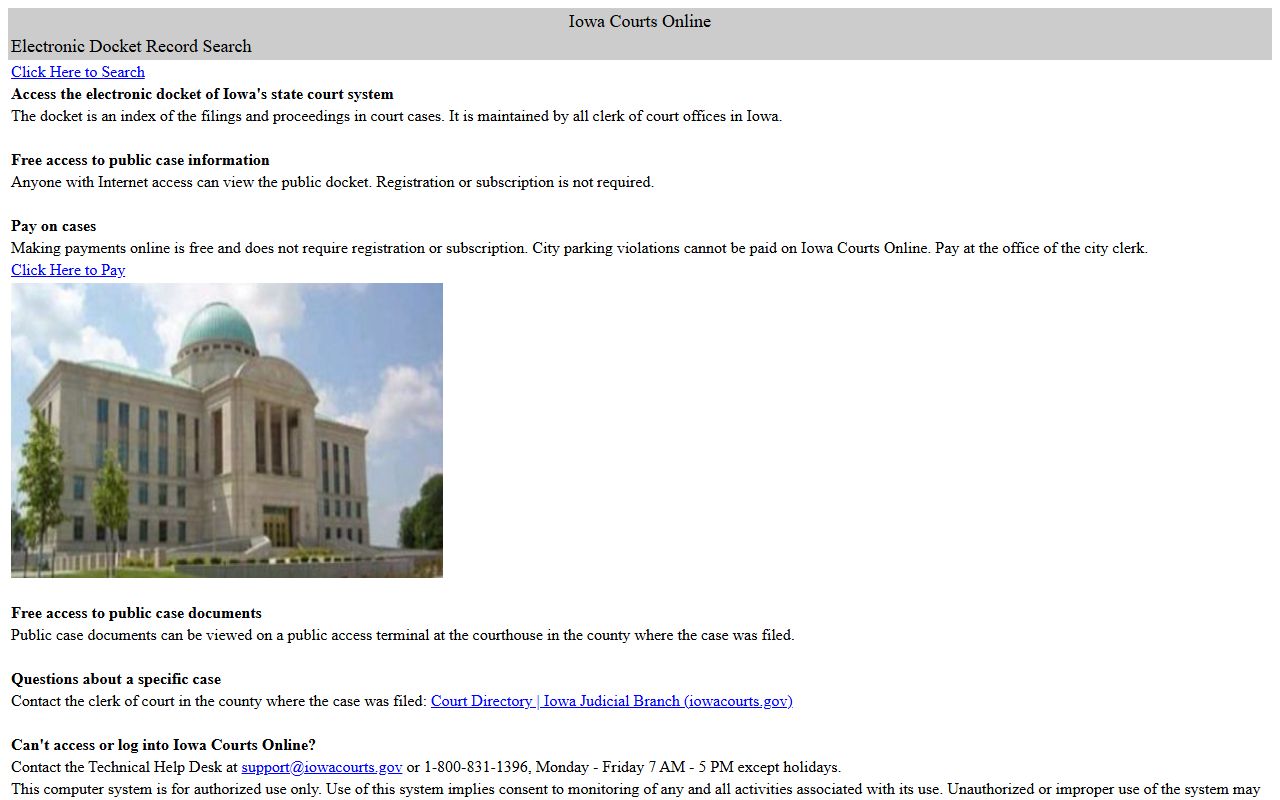
Use the statewide court system for filed charges, then confirm current jail custody through the sheriff or jail if the person may still be confined.
Carroll County Court Search Fields
The court search fields matter because Carroll County, Iowa does not publish a separate active warrant portal or a county booking case index. Iowa Courts Online is the best public route when the question is about filed charges after an arrest. A broad name search can find cases when no case number is known. A case ID search is narrower when the case number has already been found from a citation, notice, bond paper, or clerk contact.
| Search Route | Fields | Carroll County Notes |
|---|---|---|
| Name Search | Last or firm name, first name, middle name, alias fields, role, county, case type | Carroll County appears as a county option. Use CRIMINAL or ALL when the filing type is not clear. |
| Case ID Search | County, case type, and case ID parts | Carroll appears in the case-ID county list. Case types include felony, misdemeanors, OWI, search warrant, and probation revocation. |
| Citation Search | Citation number | Useful when the arrest or court contact began as a traffic or citation matter. |
| Advanced Case Search | Registered-user tools | Not the same as the free public search. Public users can still search ordinary trial-court records. |
For documents that are not viewable through the public web index, the Iowa Judicial Branch says public case documents can be viewed at a public-access terminal in the county courthouse where the case was filed. The Carroll County Clerk of Court is at 114 East 6th Street, Ste. 5, Carroll, IA 51401. The phone number is (712) 792-4327, and the court email is carroll.county.clerk@iowacourts.gov.
Charges After a Carroll Arrest
Formal court records after an arrest depend on the charging document. Iowa practice can involve a criminal complaint, a trial information filed by the prosecutor, or an indictment from a grand jury. Official Carroll County Attorney duties include prosecuting preliminary hearings for charges triable on indictment, attending the grand jury when needed, and preparing informations and bills of indictment. Those duties explain why the prosecutor's filing may not match the first jail booking label word for word.
| Document | Who Uses It | What It Does | Record Note |
|---|---|---|---|
| Complaint | Law enforcement or prosecutor | Supports the initial criminal accusation and may begin the case process. | Often tied to the first appearance and early bond review. |
| Trial Information | County Attorney | States formal charges the prosecutor files in Iowa criminal procedure. | Can replace or refine the arrest-stage charge language. |
| Indictment | Grand jury, with prosecutor duties | Charges a case through grand-jury action. | More common in serious matters or when indictment procedure is used. |
These documents are not mugshots and do not prove guilt. They are court filings or court-related papers that describe the charge path. A person remains presumed innocent unless a plea, verdict, or other conviction is entered by the court.
Carroll County Charge Status
Charge status language can change as a Carroll County court record moves forward. A pending charge has not reached final disposition. A filed charge has been accepted or entered into the court system. An amended charge has changed after filing, while a reduced charge is lowered to a less serious offense. A dismissed charge ends without conviction on that count. An acquittal means not guilty after trial or another qualifying proceeding.
| Status | Plain Meaning | Why It Matters |
|---|---|---|
| Pending | The case or charge is still open. | Bond, hearings, and court orders may still change. |
| Filed | The formal charge has entered the court system. | This is the court record after arrest, not just the jail intake label. |
| Amended or Reduced | The charge was changed or lowered. | Search both early and later docket entries before relying on one charge name. |
| Dismissed | The charge ended without conviction on that charge. | Dismissal may support later expungement if Iowa law allows it. |
| Convicted | Guilt was entered by plea, verdict, or qualifying adjudication. | Sentencing and DOC transfer records may follow. |
| Deferred Judgment | Judgment may be deferred subject to conditions. | Public access and expungement depend on the statute and case details. |
Probation revocation and search warrant case types need careful reading. A probation revocation can lead to arrest or custody even when there is no brand-new criminal charge. A search warrant case type in Iowa Courts Online is not a public Carroll County active warrant list.
Bond After Carroll County Arrest
Iowa Code Chapter 811 controls pretrial and post-trial release, while Iowa criminal rules control the initial appearance. Bailable defendants are to be released on personal recognizance or unsecured appearance bond unless the magistrate finds that those terms will not assure appearance or will risk another person's safety or public safety. The court can add conditions, such as supervision, travel limits, no-contact orders, deposit bond, cash or surety bond, or return-to-custody terms.
| Bond or Release Type | How It Works in Iowa Records |
|---|---|
| Personal Recognizance | Release based on a promise to appear when the court finds that sufficient. |
| Unsecured Appearance Bond | A bond obligation without posting the full cash amount up front unless forfeited. |
| 10 Percent Deposit Bond | A deposit condition the court may allow when lesser release terms are not enough. |
| Cash or Surety Bond | Money or surety backing posted as a release condition. |
| No-Bond or Hold Status | Release is blocked by court order, another agency hold, detainer, or outside warrant. |
No official Carroll County jail bond-payment instruction page was located. Call the Sheriff's Office or jail at (712) 792-4393 to confirm current accepted payment methods, hours, and whether a specific bond must be posted through the court or the jail. Court fines and fees are different from jail bond.
Carroll County Arrest Warrants
No official Carroll County public active-warrant list or warrant search portal was located in the official county sources reviewed. A warrant may still lead to a jail arrest and a later court record. The practical search path is to call the Carroll County Sheriff's Office at (712) 792-4393, search Iowa Courts Online for related cases, contact the Clerk of Court for court-file access, or use an open-records request when seeking sheriff records that are not published online.
Warrant words have distinct meanings. An arrest warrant authorizes an arrest tied to an allegation or failure to appear. A bench warrant is often tied to missing court or failing to comply with an order. A search warrant authorizes a search of a place, person, or property. A fugitive warrant or hold can come from another county, state, federal agency, or immigration authority and may keep a person in custody after local bond is posted.
Note: A Carroll County court record can show warrant activity, but it is not the same as a complete active-warrant database.
Charges Versus Convictions
An arrest, a jail booking, and a filed charge are not the same as a conviction. Court records after a Carroll County jail arrest may show allegations long before the case reaches a plea, trial, dismissal, or sentencing. That distinction matters for ordinary case tracking and for background checks. A charge says what the government alleges. A conviction reflects a court result.
| Point of Comparison | Charge | Conviction |
|---|---|---|
| Stage | Accusation or formal filing after arrest. | Final guilt finding by plea, verdict, or qualifying adjudication. |
| Proof Level | Early filings can rest on probable cause or prosecutor review. | Criminal guilt requires proof beyond a reasonable doubt or a valid plea. |
| Record Effect | May remain pending, be amended, or be dismissed. | Can lead to sentencing, jail, probation, prison, or fines. |
| Search Location | Iowa Courts Online, clerk records, and sometimes jail booking records. | Iowa Courts Online, clerk records, DCI history, and DOC records if sentenced to state custody. |
Sealed and Expunged Records
Public access is broad, but it is not unlimited. Iowa Code Chapter 22 gives access to public records unless an exception applies. Iowa Code section 22.7 lists confidential categories, including peace officer investigative reports in section 22.7(5). Iowa Code Chapter 901C governs expungement of qualifying acquittals, dismissals, and some misdemeanor convictions.
| Point of Comparison | Sealed or Confidential | Expunged |
|---|---|---|
| Public View | Hidden or limited for public-access purposes. | Removed from ordinary public access when the statute applies and the court grants it. |
| Reason | Juvenile status, confidentiality law, court order, investigation limits, or protected information. | Qualifying dismissal, acquittal, deferred result, or eligible misdemeanor path under Iowa law. |
| Who Decides | Court rules, clerk access rules, sheriff redactions, or statute. | The court, based on a qualifying request or statutory process. |
| What to Do | Ask the clerk or records custodian which law limits access. | Review the court case and Iowa Code Chapter 901C, or seek legal advice. |
Restricted records may also involve juvenile cases, medical or mental-health details, victim safety, confidential informants, and investigative reports. Carroll County's open-records policy says confidential material may be redacted from otherwise open records and that statutory authority for redactions should be provided.
Carroll County Criminal History
Court records after a jail arrest are not the same as an Iowa criminal history record check. The Iowa DPS Division of Criminal Investigation handles statewide criminal history record checks. DCI requests may be made online, by mail, fax, email, or in person, and the research notes a $15 fee per last name. Iowa.gov says the database contains Iowa arrests only and does not include other states, FBI records, or federal convictions. It also says arrest information more than 18 months old is not provided if DCI lacks final disposition.
Important: Do not treat a court search, jail booking, or old arrest note as permission for employment, housing, credit, insurance, or other FCRA-regulated screening.